
This audio is auto-generated. Please let us know if you have feedback.
While large, heavy, super-quick electric vehicles underscore the genre’s incredible performance potential, there’s more of a physics challenge — and a tougher puzzle — to develop lean and efficient EVs that are competitive on price versus gas-powered vehicles.
That’s part of what Ford set out to do with its Universal Electric Vehicle platform, which is due to launch in 2027 as a midsize pickup with a target starting price of around $30,000. The electric truck is slated to be built at the automaker’s assembly plant in Louisville, which formerly built the Escape SUV. The new EV is one of five more affordable vehicles Ford has promised to launch by 2030.
To get there, the company had to face the puzzle differently — by not tallying costs on a part-by-part basis. According to Alan Clarke, Ford’s Executive Director of Advanced EV Development, a vicious weight spiral can result from grabbing low-cost off-the-shelf components in order to meet performance targets, then adding a bigger battery to meet driving range or more heavy-duty components support the added weight. To avoid that, Ford’s UEV platform team took a different tactic, justifying and tracking the tough trade-offs that can ultimately bring ripple effects to an EVs overall efficiency, which it referred to as “bounties.”
“In a low-cost vehicle, it can feel counter intuitive to increase the cost of a part just to decrease its weight; but if we can give that weight reduction a value in terms of the battery cost, then we can decide if making the part lighter and more expensive actually saves us more money than adding additional battery,” summed Clarke, in a video revealing the automaker’s novel design approach.
Some decisions pay dividends well beyond their price or weight advantage, Clarke explained in another blog post. He said that batteries can account for about 40% of an EV’s total cost.
In a background session with media last month, Clarke explained that the bounties have been a key element to how the team has been able “to really tangibly show every engineer, every product designer working on the product, how they impact the customer, how they impact the cost of the vehicle, on a daily basis as they do their work.”
Although it’s a new way of thinking about vehicle development at Ford, the approach isn’t entirely different than upstarts like Lucid and Tesla.
Lucid, for instance, applied an efficiency-focused approach around a slim motor design and 900+ volt system architecture for its Air sedan — even contouring the battery pack for aerodynamic advantages. Through a suite of in-house-designed components also used in the Gravity SUV, Lucid doesn’t have to add a bigger and more costly battery pack to extend range. The company achieved 420 miles in the base Air Pure with a battery offering 84 kWh of usable capacity.
While exact specs for driving range, charging and more for Ford’s new EV are yet to come, its $30,000 price target builds on such approaches. The automaker’s goal is to deliver a potentially transformative product in an EV market that urgently needs affordability, along with higher margins.
Here are a few key points from the automaker on how it’s applying those bounties and cutting big-picture weight and cost rather than bean-counting.
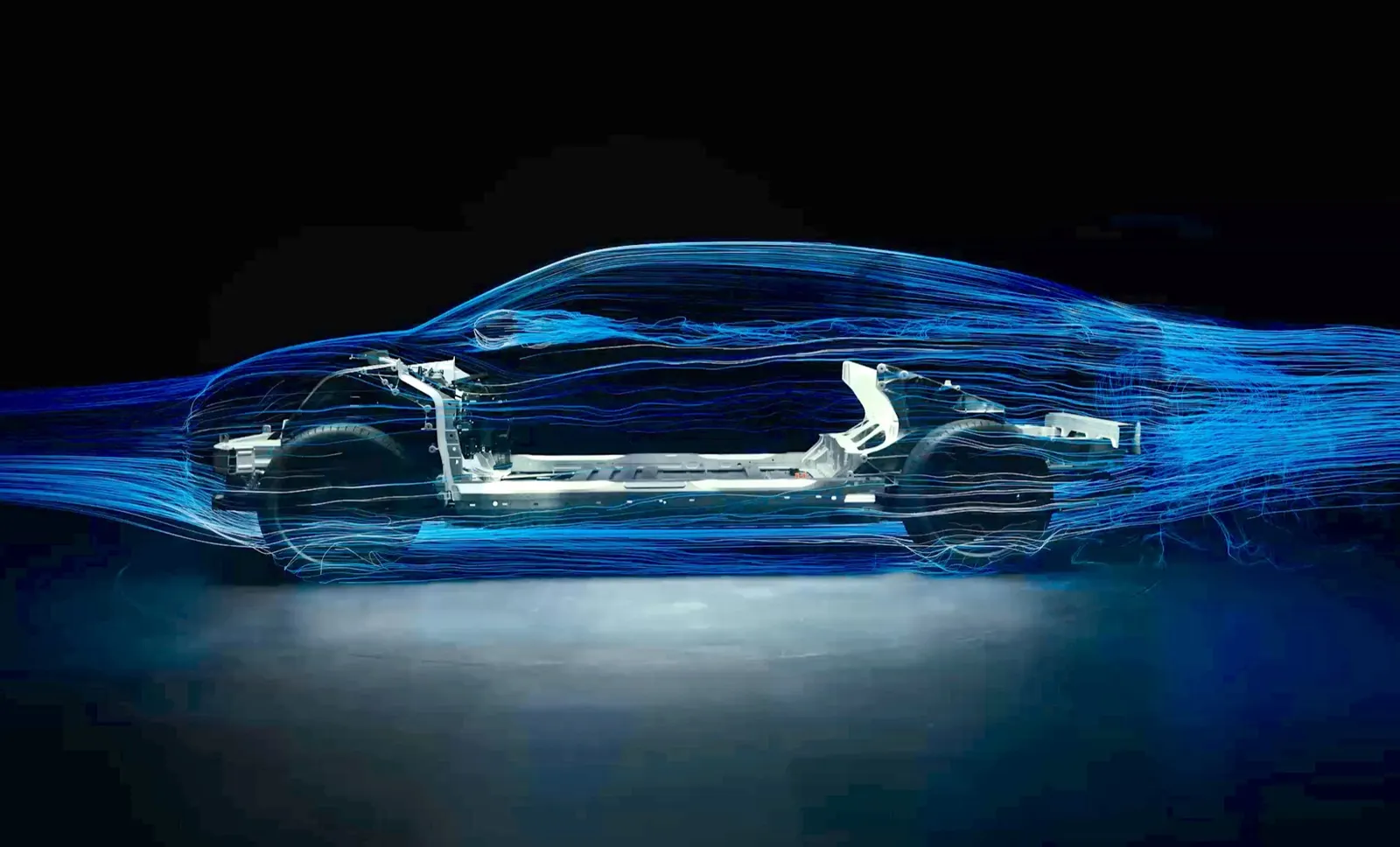
Future Ford electric pickup in profile. A gently rounded roofline pays dividends.
Courtesy of Ford
A smoother pickup shape
Considering the brick-like shape of most contemporary pickups, how these vehicles cut through the air might appear a low priority. But Ford says that it considered aerodynamics from the start, tasking F1 racing aerodynamicists to fine-tune the flow of air around its truck at speeds up to 87 mph.
Ultimately, Ford’s approach led to underbody aerodynamics considerations — like sculpting the motor case for airflow, and “hiding” the rear wheels in the wake of the front tires. Its UEV platform engineers also gently rounded the truck’s roof line to guide airflow across a “virtual surface” above the pickup bed. “To the air, it’s no longer a truck,” said Clarke.
Ford also came up with a completely new design for the side mirrors that consolidates mechanical components, so that the motor for adjustments and folding could be made 20% smaller, which reduces mass and saves 1.5 miles of range, according to Clarke.
According to Ford’s blog post, its obsession with aerodynamics adds up to 4.5 miles of range, with an aerodynamic efficiency that’s 15% better than any other pickup on the market today.
“If the same battery was married to the aerodynamics of the most aerodynamically efficient midsize gas truck in the US, we believe our new electric truck would have nearly 50 miles or 15% more driving range and a 30% improvement at highway speeds,” summed Advanced EV Aerodynamics senior manager and blog post author Saleem Merkt.
Not 800-volt, but simplified and software-defined
While some EVs utilize 800-volt system architectures, Ford’s UEV’s will use a 400-volt system. But the automaker notes the bigger payoff is switching from a 12-volt accessory system to a 48-volt one, allowing for smaller-gauge wiring. The electric pickup also uses a zonal architecture, with just five main modules replacing what would otherwise be dozens of electronic control units scattered around the vehicle. It’s the same approach that Rivian took for its forthcoming R2. These two top-level choices eliminate 4,000 feet of wiring and 22 pounds of weight compared to Ford’s first-generation EVs.
Ford also eliminated redundant pieces for its in-house designed of “E-Box”, which consolidates several major power electronics into a single compact module, including the DC-to-DC converter and AC-to-DC charging electronics. Ford also reduced parts for the EV’s vehicle-to-home bidirectional charging system.
According to Anil Paryani, Ford Executive Director of Engineering, the UEV platform employs edge computing — allowing it to process data locally within the vehicle. It also features a distributed network architecture that allows Ford’s Auto Motive Power software team to push out OTA updates. Ford acquired EV charging technology developer Auto Motive Power in 2023. The startup’s innovation allows for adaptive battery charging and cold-climate performance at the vehicle level.
To further reduce weight, Ford is using aluminum unicastings for the EV’s body structure, which eliminates dozens of parts. While the Maverick pickup has 146 structural parts, Ford’s mid-size electric truck will have just two, with 25% fewer fasteners and fewer joints and sealing needs. The unicastings are 27% lighter than the “other best castings that have launched on the market today,” according to Clarke.
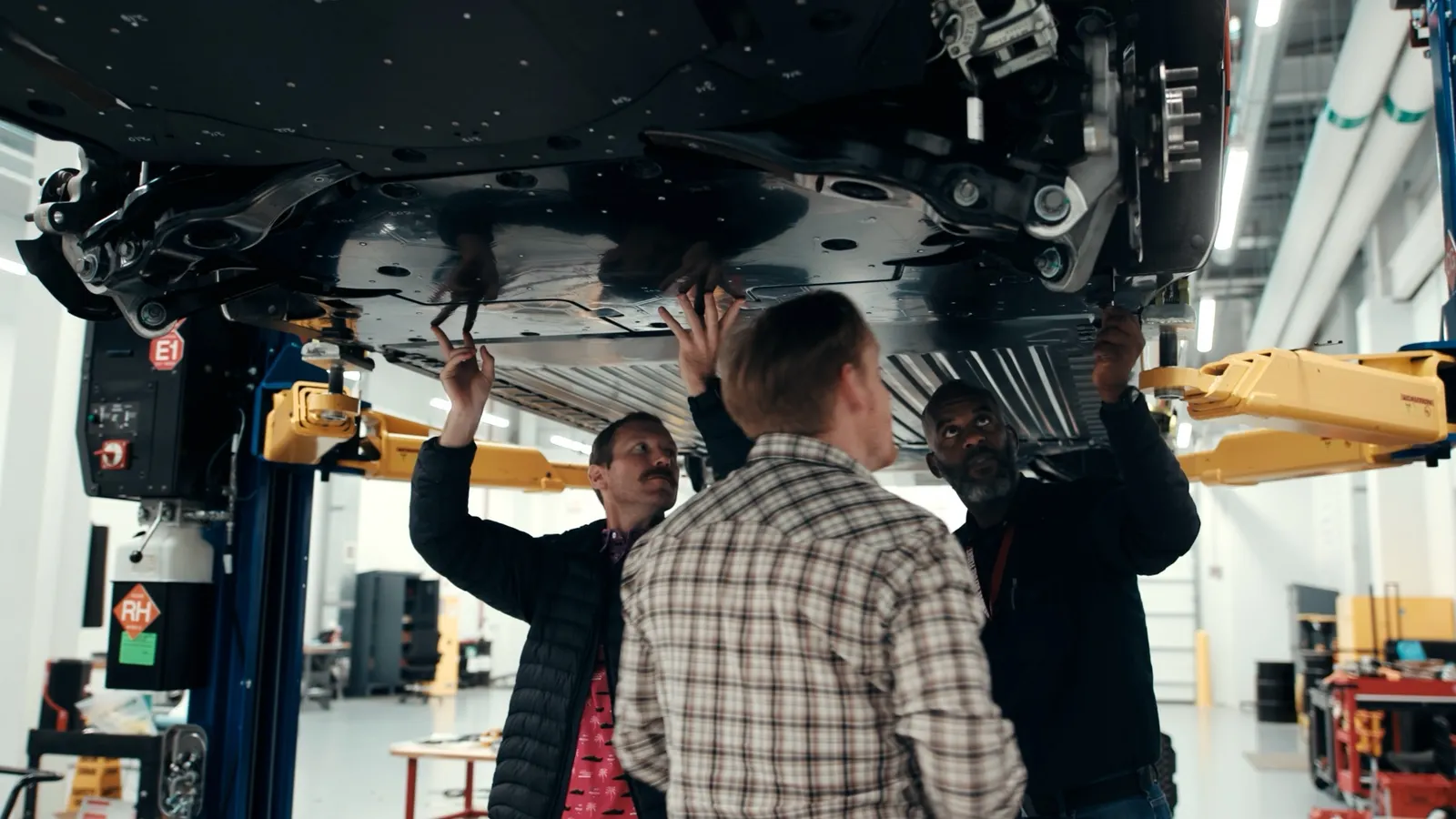
Ford UEV platform. Underbody aerodynamics will not be an afterthought.
Courtesy of Ford
The battery system has also been designed to reduce weight and the number of parts. Ford is employing lithium iron phosphate cells that are free of nickel and cobalt using a cell-to-structure battery pack design, effectively making it an integral part of the body.
The LFP cells will be manufactured at Ford's BlueOval Battery Park in Marshall, Michigan, the automaker announced in a December press release. Clarke described LFP batteries as having a proven, long-lasting battery cell chemistry that “ships in millions of vehicles today.”
The battery management electronics are contained within the battery pack using a multi-layer flexible circuit board that “reduces hundreds of busbars and wires into a single part,” Clarke said in the video. “We can measure voltage, temperature, and connect each cell using this hyper-efficient module.”
Less friction, more regenerative braking
In the pursuit of reducing mechanical friction, the team “obsessed over every single bearing, seal, and joint,” according to Merkt. An adjustable-rate oil pump cools the motors and gears, and a redesigned regenerative braking system will save about $100 in battery cost.
Ford representatives explained that it’s using a mix of traditional suppliers and contract manufacturers that the automaker has never used at higher volume before. While the cross-section of them is different, the total number of suppliers isn’t drastically different.
“Gas cars have been optimized over the last 100 years, but there are still countless ideas for reducing the cost and increasing the capabilities of electric vehicles,” said Clarke, who assessed that the rework of tools, systems, and the supply chain that the team has done for this product “will organically find its way into a multitude of Ford products over the next few years.”
The drive units and the energy conversion system, for instance, could be installed in any EV, including Ford’s other hybrids, he said. “We're trying to create this virtuous cycle of improvement that comes from product reuse and intelligent architecture decisions.”



 English (US) ·