
As a surprise to everyone, recently Toyota launched the final facelifted iteration of its most popular MPV, the Innova Crysta. This MPV, after dominating the Indian automotive market for such a long time, will finally be discontinued in March 2027. Now, a lot of people are wondering what is next in line from Toyota after the Innova Crysta gets discontinued. As a result, we are here to help you in knowing what Toyota is planning to do after the discontinuation of Innova Crysta.

Toyota Innova Crysta gets its final facelift
Before going into the details of what's coming next from Toyota as a replacement for the Innova Crysta, we have to talk about the final update that has been given to the Innova Crysta. This time around, this premium MPV has been given a number of cosmetic changes. On the outside, it gets a revised front grille with added chrome garnishes on the bumper.
Depending on the variant, buyers will get automatic LED projector headlamps, halogen fog lamps, and 16-inch or 17-inch alloy wheels. Moving to the inside, Toyota is offering the newly facelifted Crysta with dual-tone seat upholstery along with Grace Copper finish inserts on the steering wheel and door trims. It has also given it features including a wireless charger and tyre pressure monitoring system as well.
As for the pricing of the updated Innova Crysta, it now starts from Rs 19.72 lakh and goes all the way up to Rs 26.63 lakh, ex-showroom. When compared to the previous version, prices have increased by Rs 83,000.

Why is Toyota discontinuing the Innova Crysta?
A lot of people who are not aware might have this question in their mind as to why Toyota is discontinuing a vehicle which still has such a strong demand in the country. Well, the answer to this is in the upcoming CAFE III emission norms. These upcoming regulations will require all automotive manufacturers to reduce their fleet-wide carbon emissions by a huge margin.
Currently, the Toyota Innova Crysta is a heavy ladder-frame diesel MPV which is very efficient for its size. It still contributes more towards fleet emissions compared to its strong hybrid Innova Hycross counterpart. So, in order to reduce its carbon emissions, the company is shifting its focus towards strong hybrids.
Under the upcoming CAFE regulations, every strong hybrid vehicle sold will receive super credits and will be counted as two vehicles while calculating fleet emissions. As a result, Toyota has decided that it will not be offering any more diesel MPVs in India, and it believes that the future of mobility is electrified powertrains rather than diesel.
What will replace the Innova Crysta?
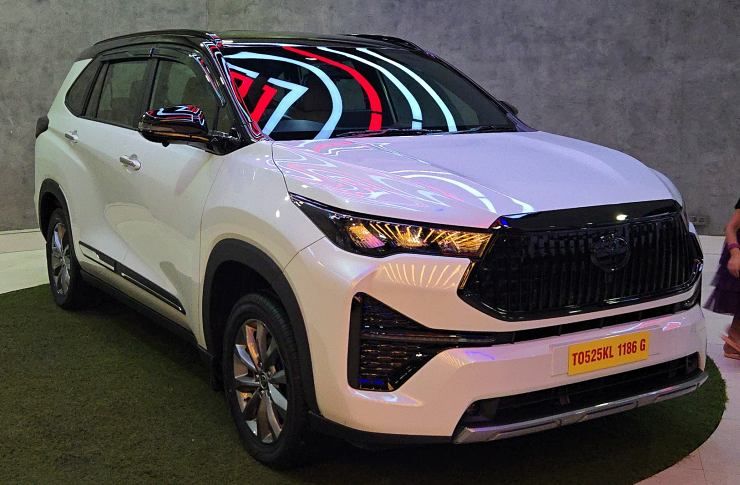
As per the reports, the first step in Toyota's strategy will be to replace the Innova Crysta with a more affordable version of the Innova Hycross Hybrid. It has been reported that Toyota is developing a lower-spec hybrid Hycross internally known as the 840D. This model will be positioned as a fleet-friendly offering.
Unlike the premium Hycross variants which are currently on sale, this new version is expected to be affordable. It will most likely come equipped with fewer features and less premium finishes in order to keep its pricing competitive.
However, it is believed that the strong hybrid powertrain will remain one of its biggest highlights of this MPV. The 2.0-litre strong hybrid powertrain of Hycross offers excellent fuel efficiency, and it is compatible with all the regulations that will be required by the authorities in the coming period.
Flex-fuel Hycross in development

Apart from the more affordable version of the Innova Hycross, Toyota is currently planning to launch a flex-fuel version of this MPV as well. The company has already showcased flex-fuel versions of the Innova Hycross on multiple occasions. In fact, Toyota unveiled the world's first BS6 Stage 2-compliant electrified flex-fuel vehicle based on the Innova Hycross.
The main highlight of the prototype that was shown was that it could run on E100 fuel, which is pure ethanol. And as we know, the government of India is currently pushing towards higher levels of ethanol blending, it will help Toyota as it will launch its flex-fuel Hycross.
Toyota's first electric MPV is also coming

Another major change in Toyota's future MPV lineup will be the introduction of an all-electric people mover. Maruti Suzuki is currently working on an electric MPV which will be based on Maruti Suzuki’s upcoming YMC EV MPV. This model is expected to be launched by the end of 2026 and will become Maruti's first electric seven-seater MPV.
The Toyota version of YMC will be based on the same platform as the eVitara, and it is expected to come with battery pack options of 49 kWh and 61 kWh. Its range will most likely be around 440 km and 543 km, respectively.
As for the feature highlights, it is expected to come offered with a large touchscreen infotainment system, digital instrument cluster, captain seats, panoramic glass roof, wireless charging, Level 2 ADAS, connected car technology, and a 360-degree camera.
Rumion will also get a next-generation update

Apart from hybrids and EVs, Toyota is also expected to launch the new generation of the Rumion MPV. It is believed that the upcoming Rumion will grow in size from 4.39 metres to 4.43 metres in length. This increase will most likely come because of the longer rear overhang, which will improve boot space.
This added length will benefit CNG buyers, as the larger luggage area will help in increasing the space which currently gets occupied by the CNG cylinder. Toyota is also expected to add six airbags as standard along with TPMS and other feature updates. The existing 1.5-litre petrol and CNG powertrains will continue to power the next-generation Rumion.
End of diesel MPVs at Toyota

The Innova Crysta, as we all are aware, is the most popular diesel MPV in India because it offers a combination of comfort, reliability, and ruggedness. Its time-tested 2.4-litre diesel engine is also one of the biggest reasons behind its success. However, once the Crysta is discontinued in 2027, Toyota's MPV portfolio will not have any more diesel-powered vehicles, and the company will move towards strong hybrids, flex-fuel hybrids, and electric MPVs.



 English (US) ·